Napoleonic Wars
War and PeaceThe Napoleonic Wars form the historical arena in which private motives become collective catastrophe and, retrospectively, are mistaken for a coherent design. Across the period, military campaigns, political decisions, social sacrifice, urban destruction, and personal fortunes reveal a conflict shaped less by the conscious will of great men than by the accumulated actions of millions.
Chronology and Scale
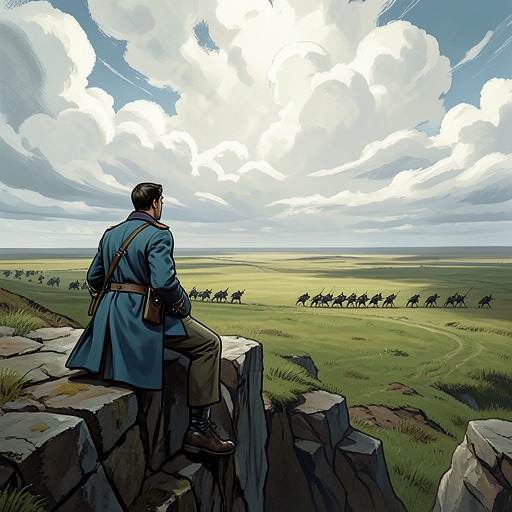
From 1805 onward, the wars repeatedly connect distant territories with immediate material pressures. In October 1805, a Russian army occupied Austrian villages and towns while new regiments arrived near Braunau, headquarters of Mikhail Kutuzov. One regiment, after a twenty-mile march, spent the night cleaning and repairing itself for inspection, producing a parade formation of two thousand men even though more than half its soldiers had boots full of holes after marching roughly seven hundred miles. The contrast between immaculate appearance and physical neglect establishes a recurring condition of the wars: military order is displayed on the surface while bodies, supplies, roads, and equipment remain under strain.
The campaign soon became a struggle of movement and exhaustion. Pursued by a French army of one hundred thousand under Napoleon Bonaparte, Mikhail Kutuzov’s Russian force of thirty-five thousand retreated along the Danube, fighting rearguard actions at Lambach, Amstetten, and Melk only as far as necessary to preserve its heavy equipment. After the Austrian defeat at Ulm, the Austrian troops who had joined Kutuzov separated from him, leaving his army weak and exhausted. The defense of Vienna became impossible, and the remaining objective was to join advancing Russian forces without suffering the destruction that had overtaken Mack’s army. At Krems, however, the Russians halted, defeated Marshal Mortier’s division, captured banners, cannon, and two enemy generals, and held the field for the first time after a fortnight of retreat.
The same material logic reappears in the later campaign. The Pavlograd Hussar Regiment, attached to Platov’s independent division, exchanged fire with the enemy, took prisoners, and captured Marshal Oudinot’s carriages. Yet near a ruined German village in the spring thaw, impassable roads prevented transports from arriving, provisions and fodder ceased, and soldiers searched deserted villages for potatoes. The regiment lost nearly half its men to hunger and sickness despite suffering only two wounded in action. Feverish soldiers preferred to remain on duty because the hospitals seemed to offer almost certain death, and the men survived on a plant they called Mashka’s sweet root. The wars therefore appear not as a sequence of isolated victories and defeats but as a system in which supply, footwear, transport, food, disease, and weather determine what armies can actually do.
Armies, Society, and Mobilization
The wars draw their strength and destructiveness from society beyond the battlefield. In 1812, millions of Western European troops, together with the people required to transport and feed them, moved eastward toward the Russian frontier, while Russian forces had been concentrating there since 1811. On June 12, 1812, the Western armies crossed the frontier. The resulting violence included theft, fraud, treachery, forgery, false money, burglary, incendiarism, and murder on a scale that the historical record presents as both enormous and morally disorienting: those committing such acts did not necessarily regard them as crimes while participating in the war.
The Moscow nobility’s response shows how the state converted private property and dependent populations into military capacity. At the Sloboda Palace on July 15, 1812, nobles and merchants gathered while the Emperor was expected to arrive. Count Fyodor Rostopchin urged them to supply men rather than spare themselves. The resolution recorded that the Moscow nobility and gentry would furnish ten fully equipped men from every thousand serfs, following the example of the Smolensk gentry. The meeting joined aristocratic ceremony, merchant wealth, imperial authority, and the mobilization of serf manpower in a single administrative act.
Yet public patriotism never replaces private interest completely. The narrative stresses that people during the invasion were not all consciously sacrificing themselves, mourning Russia, or thinking about the general course of events. Many were guided by personal concerns, and precisely those unselfconscious activities could become historically effective. Attempts to act heroically for an abstract national good could instead become useless or harmful, as with Pierre Bezukhov’s and Mamonov’s regiments, which looted Russian villages, or the lint prepared by young women that never reached the wounded. The war’s social energy thus emerges from a tension between declared patriotism and the practical, often unconscious conduct through which people actually sustain or resist historical movements.
Moscow, Occupation, and Popular Resistance
The evacuation and burning of Moscow are treated as consequences of a collective situation rather than as the achievement of one decisive instigator. After the Battle of Borodino, abandoning Moscow and retreating beyond it without another battle had become inevitable. Wealthier inhabitants departed with what they could carry, leaving houses and much of their property behind, while poorer people remained and destroyed what was left. Their departure was not necessarily expressed through patriotic speeches or theatrical self-sacrifice; it operated as an unobtrusive and organic response to the expected occupation.
When the French entered the deserted city, the army dispersed through it like water spreading over dry ground. Cavalrymen occupied abandoned merchant houses, officers selected carriages in Carriage Row, and both soldiers and commanders were drawn toward the wealth left behind. The few inhabitants who remained invited officers into their homes in the hope of protection from plunder. Moscow’s abundance became a trap: the famished army moved deeper into the city in search of greater riches, and the resulting looting and fires destroyed both the wealthy urban environment and the army that had entered it.
The Fire of Moscow was consequently attributed by each side to an opposing human culprit: the French blamed the fierce patriotism of Count Fyodor Rostopchin, while the Russians blamed French barbarity. The account rejects both explanations as sufficient. A deserted wooden city occupied by soldiers who smoked, lit fires, and cooked meals twice daily was placed in conditions in which conflagration was unavoidable, much as sparks falling on shavings must eventually produce fire. The episode embodies the broader historical argument: later observers search for a responsible individual because individual agency is easier to narrate than a convergence of population flight, urban construction, military occupation, camp practice, and accumulated sparks.
Popular resistance also changes the form of war. In a conflict that acquires a national character, scattered groups attack concentrated forces singly, retreat before superior strength, and return when opportunity appears. This method, used by guerrillas in Spain, mountain tribes in the Caucasus, and Russians in 1812, violates the conventional tactical rule that an attacker should concentrate forces to achieve superiority at the moment of conflict. The label guerrilla warfare does not explain the phenomenon; rather, the phenomenon exposes the limits of military systems built around formal rules and massed armies.
Historical Causation and Power
The Napoleonic Wars challenge explanations centered on diplomatic incidents or the intentions of rulers. The invasion of Russia is described through familiar historical claims involving the wrongs done to the Duke of Oldenburg, the Continental System, Napoleon’s ambition, Alexander’s firmness, and diplomatic mistakes. Such explanations imply that a more skillful note from a diplomat, or a conciliatory message from Napoleon Bonaparte to Alexander, might have prevented the war. Each contemporary group naturally identified a cause that reflected its own position: Napoleon blamed English intrigues, English parliamentarians blamed Napoleon’s ambition, businessmen blamed the Continental System, generals blamed the need for employment, and diplomats blamed concealed alliances or awkward wording.
The alternative explanation is a theory of constrained action. Napoleon Bonaparte began the war because he could not resist going to Dresden, the homage he received, the attraction of a Polish uniform, a June morning, and bursts of anger before Kurakin and Balashev. Alexander I refused negotiations because he felt personally insulted. Mikhail Barclay de Tolly tried to command responsibly because he wished to fulfill his duty and gain a reputation as a great commander. Nikolai Rostov charged the French because he could not restrain his desire to gallop across a level field. Countless others acted through fear, vanity, habit, circumstance, and immediate aims. They believed they were acting freely, yet they became involuntary instruments of a historical process whose result none of them anticipated.
The destruction of the French army in 1812 is clear in retrospect: it advanced into the heart of Russia late in the season without preparation for winter, and the burning of Russian towns aroused hatred among the population. But that outcome was not visible to contemporaries. No one foresaw that these conditions could destroy an army of eight hundred thousand, regarded as the best in the world and led by its best general, in conflict with a Russian army half its size and commanded by inexperienced leaders. The distance between what later appears inevitable and what was knowable at the time is one of the period’s central historical problems.
The same problem leads to the question of power. Once historians abandon the ancient belief that a nation’s will is divinely subordinated to a chosen ruler, they must explain what makes one person’s orders effective. Napoleon Bonaparte could order six hundred thousand men to war, but that power cannot simply be physical strength, nor can it be reduced to superior moral qualities or genius. History includes rulers such as Louis XI and Metternich whose command over millions did not rest on exceptional virtue. Power must instead be sought in the relationship between the person who wields it and the people who obey, in the social and institutional exchange through which private actions become state action.
Legacy and Human Consequences
The wars leave consequences that exceed the intentions of their participants. During the twenty-year movement that began in the west, reached Moscow in 1812, and then turned back toward Paris, fields remained untilled, houses burned, trade changed direction, millions migrated, and populations were impoverished or enriched while millions of Christians killed one another despite professing a law of love. The geographical movement of armies becomes a movement of peoples, property, labor, hunger, and memory.
Their consequences also penetrate family life after the campaigns end. When Count Ilya Rostov died, Nikolai Rostov was serving with the Russian army in Paris. He resigned his commission and returned to Moscow, where the count’s debts proved to be double the value of the property. Refusing to reject the inheritance because he regarded that refusal as an insult to his father’s memory, Nikolai accepted the debts as well. The estate was sold at auction for half its value, thirty thousand rubles from his brother-in-law Bezukhov covered debts regarded as genuinely due, and Nikolai entered government service to avoid imprisonment. The war period therefore survives not only in military results but in depleted estates, forced careers, obligations between generations, and the reorganization of domestic life.
The Napoleonic Wars finally become a test of historical language itself. Great men appear to direct events, but the text repeatedly places their intentions beside the conditions that frustrated them: ruined roads, absent supplies, sickness, popular hostility, abandoned cities, and the uncontrolled actions of soldiers and civilians. The period’s decisive significance lies in that contrast. It shows history as a process made by human beings who pursue particular ends, yet whose combined actions produce a transformation larger than any plan, explanation, or claim to personal mastery.